Dog Age Calculator: Dog Years to Human Years by Size
A dog age calculator converts calendar age to an approximate human-year equivalent. Example: a 10-year-old medium dog is about 56 human years on this size chart (24 + 8×5). Life-stage labels follow AAHA bands; the year chart itself is AVMA/client-education style, not the AAHA guideline text.
How to use the dog age calculator
- Enter your dog’s age in years, including fractions (for example 3.5 for three and a half).
- Choose a size class from toy to giant, based on expected adult weight.
- Pick the method: the default size-aware model, or the illustrative log curve for comparison.
- Read the human-year equivalent and the AAHA-style life stage label.
Why the 7:1 rule fails
Multiplying by seven is easy, which explains its long life. But a one-year-old dog is not a seven-year-old child: most dogs are sexually mature and near full size by their first birthday, which is closer to a mid-teen human. By the end of year two, a dog has reached what looks more like a young adult. After that, aging slows relative to the early years, and the rate depends heavily on size. Our guide on the dog years myth goes deeper.
The size-aware model used here
The default method is a piecewise human-year chart commonly used in client education (AVMA senior-pet materials and AAHA–Zoetis-style posters). The AAHA Canine Life Stage Guidelines define life stages (puppy, young adult, mature adult, senior), not this year-conversion table—we use AAHA-style bands for the stage label only.
- Year 1: about 15 human years.
- Year 2: about 9 more human years (24 total at age two).
- After year 2: add about 4 years per dog year for toy and small breeds, 5 for medium, 6 for large, and 7 for giant.
The life-stage label also depends on size. Senior status is taken to begin around 10 years for toy and small dogs, 8 for medium, 7 for large, and 6 for giant breeds. These cut-offs are approximations for education and are not diagnostic. Confirm care plans with your veterinarian.
Dog years chart (1–16) by size
Approximate human-year equivalents using the default size chart (not the Wang log curve):
| Dog age (yr) | Toy / small (+4) | Medium (+5) | Large (+6) | Giant (+7) |
|---|---|---|---|---|
| 1 | 15 | 15 | 15 | 15 |
| 2 | 24 | 24 | 24 | 24 |
| 5 | 36 | 39 | 42 | 45 |
| 8 | 48 | 54 | 60 | 66 |
| 10 | 56 | 64 | 72 | 80 |
| 12 | 64 | 74 | 84 | 94 |
| 14 | 72 | 84 | 96 | 108 |
| 16 | 80 | 94 | 108 | 122 |
Larger sizes age “faster” on this chart after year two—the same reason giant breeds often need senior screening earlier. For the myth vs science narrative, see the dog years myth guide.
About the logarithmic curve (illustrative)
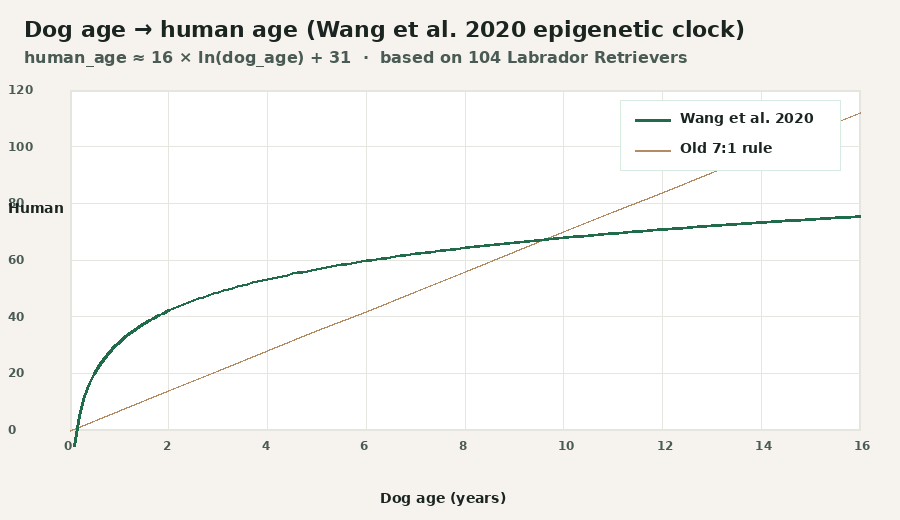
In 2020, Wang et al. compared DNA methylation patterns in 104 Labrador Retrievers and humans (Cell Systems). A logarithmic fit produced the widely shared formulahuman age ≈ 16 × ln(dog age) + 31. The calculator offers this as a comparison option because it illustrates that early aging is fast and later aging is slower.Treat the log curve as illustrative. It is single-breed, not a veterinary standard, and does not predict health or lifespan for an individual dog. For the myth vs science narrative, see the dog years myth guide.
Worked example
A 6-year-old Labrador-type dog (large): 24 + (6 − 2) × 6 = 48 human years, with a life stage of mature adult, close to the senior threshold of 7. A 6-year-old Chihuahua (toy): 24 + 4 × 4 = 40 human years, still a mature adult for several more years. The log curve would give about 59.6 for both, which shows why one-size-fits-all conversions are unreliable.
Life stages matter more than the number
The most useful thing about age is what care it prompts. Puppies need vaccination series, socialization, and growth-appropriate food. Mature adults benefit from annual exams and dental checks. Seniors typically do better with exams every six months, bloodwork, and attention to mobility, weight, and cognition. Giant breeds reach that stage years before toy breeds, so screening should start earlier for them. If you track growth earlier in life, our puppy weight calculator and the body condition helper are good companions.
Cats are different
Cats follow their own life-stage pattern, with a longer prime and less size variation. Use the cat age calculator for feline age conversion rather than applying a dog formula.
How to use the result
Use the human-year number as a conversation starter rather than a verdict. If it tells you your dog is roughly the equivalent of a 60-year-old, ask whether the care plan reflects that: twice-yearly exams, bloodwork, a mobility check, dental review, and a diet suited to the life stage. These actions matter far more than the exact number.
Frequently asked questions
Is one dog year really seven human years?
No. The 7:1 rule is a rough folk estimate that ignores size, breed, and the fact that dogs mature very quickly in their first two years. Modern life-stage guidance and research-based models give different, more nuanced answers.
How does this calculator convert dog years to human years?
By default it uses a size-aware life-stage model: about 15 human years for the first dog year, about 9 for the second, and then 4 to 7 per year depending on size. You can also compare an illustrative logarithmic curve based on epigenetic aging research.
Why do large dogs age faster?
Large and giant breeds tend to have shorter lifespans, so they reach senior and geriatric stages earlier. AAHA life stage guidelines reflect this by defining senior age by breed size. Why this happens is still being studied.
What is the logarithmic curve option?
It is a popular-science adaptation of epigenetic clock work, roughly human age = 16 × ln(dog age) + 31, from Wang et al. 2020 (104 Labrador Retrievers). It is illustrative, single-breed, and not a clinical standard.
What life stage is my dog in?
AAHA defines puppy, young adult, mature adult, senior, and end-of-life stages. The calculator maps your dog’s age and size to those labels. Your vet makes the real call based on exam findings.
Does the calculator work for mixed-breed dogs?
Yes. Choose the size class that matches the dog’s expected adult weight. If the dog is between sizes, try both and look at the range.
Formula summary
Default size chart (client-education / AVMA-style): year 1 ≈ 15, year 2 ≈ +9, then +4/+5/+6/+7 per year for toy–small / medium / large / giant. Life-stage labels use AAHA-style bands. Optional log curve: human ≈ 16 × ln(dog age) + 31 (Wang et al. 2020; 104 Labradors; illustrative only).
References
- American Animal Hospital Association (AAHA) — AAHA Canine Life Stage Guidelines Checked .
- American Veterinary Medical Association (AVMA) — Senior pet care Checked .
- Wang et al., Cell Systems (2020) — Quantitative translation of dog-to-human aging by conserved remodeling of the DNA methylome Checked .
- Wang et al., Cell Systems (2020) via PMC — Quantitative translation of dog-to-human aging (PMC full text; 104 Labradors) Checked .
Estimates only — not veterinary advice. Results are a starting point for discussion with your veterinarian, not a diagnosis or feeding prescription. Found an error? Tell me.
Calculator version 1.0 · Changelog