Dog BMI & Body Condition Helper
Dogs do not have a validated BMI like people do, so veterinarians use the 9-point Body Condition Score (BCS) instead, where 4 to 5 is ideal. This tool pairs a BMI-style weight-to-height index with the WSAVA BCS description for education only; your vet’s hands-on exam is what counts.
How to use the dog BMI and body condition helper
- Weigh your dog and enter the weight in pounds or kilograms.
- Measure height at the withers (the top of the shoulders) while your dog stands square.
- Review the BMI-style index and the suggested score, then choose the BCS description that best matches your dog’s body.
- Read the guidance for that score and book a vet visit if you see 3 or below, or 7 or above.
The Body Condition Score scale
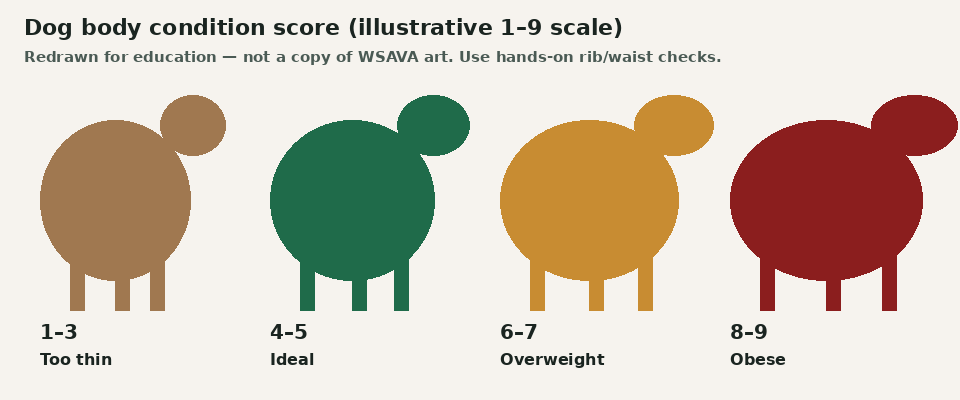
The WSAVA 9-point scale is the one most clinics use. Each score reflects how easily you can feel ribs and see the waist. The illustration below is an original educational redraw — not a copy of WSAVA artwork — and does not replace a hands-on exam:
| Score | Description | What you notice |
|---|---|---|
| 1–3 | Too thin | Ribs, spine, and hips visible or very easy to feel. |
| 4–5 | Ideal | Ribs felt easily with slight fat cover; clear waist and tuck. |
| 6–7 | Overweight | Ribs felt with difficulty; waist faint or absent. |
| 8–9 | Obese | Ribs not palpable under heavy fat; belly sags, fat deposits over spine and tail base. |
What the BMI-like index measures
The index shown by the tool is weight (kg) ÷ height at withers (m)². It borrows the arithmetic of human BMI. In people the formula was validated against disease outcomes in large populations. For dogs, no equivalent exists, and body shape varies far more: a Greyhound, a Basset Hound, a Bulldog, and a Border Collie of the same weight and shoulder height can have quite different healthy body compositions. So the index here is a rough screening aid used to suggest a starting score, and you should override it with what you see and feel.
Worked example
A dog weighing 10 kg with a withers height of 56 cm: 10 ÷ 0.56² ≈ 31.9, which the tool’s rough mapping would suggest is around a 6. A different 10 kg dog that stands 40 cm tall gives 62.5, which would map to the top of the scale. Both could be perfectly healthy. This is exactly why the index alone can mislead, and why the tool asks you to choose a BCS description yourself. If the ribs are easy to feel and a waist is visible, the BCS is around 5 regardless of the index. If the ribs are hard to find and the waist is gone, the true score is likely 7 and a plan is needed. The index is most useful for tracking the same dog over time.
Why a healthy weight matters
Overweight dogs are at higher risk of osteoarthritis, diabetes, high blood pressure, breathing problems, and some cancers. In a landmark 14-year Labrador Retriever study, dogs fed about 25 percent less than their littermates stayed leaner, lived roughly 1.8 years longer on median, and developed chronic illness later. Even a modest reduction of 10 percent of body weight in an overweight dog can improve mobility.
What to do after you get a score
- Ideal (4–5): keep measuring meals and treats, and recheck monthly.
- Overweight (6–7): calculate a calorie target with the dog food calculator, cut treats, and add walks.
- Obese (8–9): see a vet for a supervised weight-loss plan and screening for medical causes.
- Thin (1–3): see a vet; parasites, dental pain, and disease can all cause weight loss.
Limits and cautions
Puppies and pregnant or lactating dogs have different body-condition needs, so this tool is not suited to them; for growing puppies see the puppy weight calculator. Swelling, fluid, tumors, and heavy muscle can all change weight without changing fat. Water balance also matters in sick dogs; the water intake calculator can help you notice changes in drinking. Always use clinical judgment from your veterinarian over any online score.
Frequently asked questions
Is there a real BMI for dogs?
Not in the way humans have one. Human BMI is validated against health outcomes; dogs vary enormously in body shape, so there is no single validated canine BMI. Veterinarians use the 9-point Body Condition Score (BCS) instead, which this tool treats as the primary guide.
What is a good body condition score for a dog?
On the WSAVA 9-point scale, 4 to 5 is ideal. A score of 6 is slightly overweight, 7 is overweight, and 8 to 9 is obese. Scores of 3 or below suggest a thin dog.
How do I check my dog’s body condition at home?
Feel the ribs with flat fingers: they should be easy to feel under a thin fat layer. Look from above for a waist behind the ribs, and from the side for an abdominal tuck. Hard-to-feel ribs and no waist suggest excess weight.
What is the “BMI-like index” in this tool?
It is weight in kilograms divided by height at the withers in meters squared. The tool maps it to a rough BCS suggestion for education. Because dogs differ in build, it can mislead for deep-chested, short-legged, or heavily muscled breeds.
Why does obesity matter in dogs?
Excess weight is associated with arthritis, diabetes, breathing problems, and shorter lifespan. A long-term study of Labrador Retrievers found that dogs kept lean lived about 1.8 years longer on median than their overweight littermates.
My dog is overweight. What should I do next?
Have your vet confirm the score and rule out medical causes. Then calculate a calorie target with the dog food calculator, measure meals, count treats, and recheck every two to four weeks.
References
- WSAVA — WSAVA Body Condition Score Chart (Dogs)
- AAHA — AAHA Nutrition and Weight Management Guidelines
- JAVMA — Kealy et al. (2002), Effects of diet restriction on life span and age-related changes in dogs. JAVMA 220(9)
- APOP — Association for Pet Obesity Prevention
Estimates only — not veterinary advice. Results are a starting point for discussion with your veterinarian, not a diagnosis or feeding prescription. Found an error? Tell me.
Calculator version 1.0 · Changelog